NEWS / BLOGS
The plastic polluters won 2019 – and we're running out of time to stop them
Further steps have been taken to clean up beaches and seas in 2019 – but much more needs to be done
Thu 2 Jan 2020 07.46 ESTLast modified on Fri 17 Jan 2020 13.39 EST
Shares
2,526
A polluted beach in Mumbai. Novel ways to collect plastic from rivers and oceans were introduced last year. Photograph: David Levene/The Guardian
The beach at Muncar on the island of Java was revolting. The 400-yard wide, mile-long stretch of sand was feet deep in foul-smelling sauce sachets, shopping bags, nappies, bottles and bags, plastic clothes and detergent bottles. Bulldozers had cleared away and buried some of the huge mat of plastic and sand two years ago, but every tide since then had washed up more rubbish from the ocean, and every day tonnes more plastic was washed down the rivers from upstream towns and villages. Now it was fouling the fishing boats’ propellers.
“We fear for the future,” one elderly woman said. She remembered Muncar only a decade ago as one of the most picturesque towns in Indonesia and a tourist hotspot. “If it carries on like this we will be buried in plastic. We have no choice but to throw plastic into the rivers. Now we are angry. Something must be done,” she said.
Small steps towards a plastic-free world | Letters
Read more
That was January 2019. One year later, the beach heaves with plastic but the local government, working with well-funded international advisers, a recycling company and an army of volunteer collectors have worked to stem the tide of plastic reaching its beaches. It will cost millions of dollars and take years but Muncar may soon have its sand back.
See Full Article at Source: https://www.theguardian.com/environment/2020/jan/02/year-plastic-pollution-clean-beaches-seas

A new push for a coherent U.S. recycling policy
More than a dozen trade groups led by the Consumer Brands Association (CBA) Wednesday morning launched a coalition to help craft federal policy that would "fundamentally reimagine the U.S. recycling system."
Why it matters: The coalition includes some prominent K Street players and hopes to create "consistent rules and practices" around what's now a crazy-quilt of recycling systems nationwide.
"The United States is facing a packaging and plastic waste crisis greatly exacerbated by nearly 10,000 unique recycling systems," said CBA President Geoff Freeman in a statement.
Petrochemicals used in creating new plastic is a big source of oil demand.
See Full Article at Source: https://www.axios.com/us-recycling-policy-push-3c5fd492-b125-4eb0-85ed-fa5f4b13289c.html
Single-use plastic: China to ban bags and other items 20 January 2020

China, one of the world's biggest users of plastic, has unveiled a major plan to reduce single-use plastics across the country.
Non-degradable bags will be banned in major cities by the end of 2020 and in all cities and towns by 2022.
The restaurant industry will also be banned from using single-use straws by the end of 2020.
China has for years been struggling to deal with the rubbish its 1.4 billion citizens generate.
The country's largest rubbish dump - the size of around 100 football fields - is already full, 25 years ahead of schedule.
In 2017 alone, China collected 215 million tonnes of urban household waste. But national figures for recycling are not available.
China produced 60 million tonnes of plastic waste in 2010, followed by the US at 38 million tonnes, according to online publication Our World in Data based at the University of Oxford.
See Full Article at Source: https://www.bbc.com/news/world-asia-china-51171491
How Fossil Fuel Companies Are Killing Plastic Recycling
Plastic trash has overwhelmed America. Fossil fuel companies are about to make it worse.
So many things we buy come packaged in plastic containers or wrappers that are meant to be used once, thrown away and forgotten ― but they don’t break down and can linger in the environment long after we’re gone. It’s tempting to think that we can recycle this problem away, that if we’re more diligent about placing discarded bottles and bags into the curbside bin, we’ll somehow make up for all the trash overflowing landfills, choking waterways and killing marine life.
For decades, big petrochemical companies responsible for extracting and processing the fossil fuels that make plastics have egged on consumers, reassuring them that recycling was the answer to our trash crisis. Just last month, Royal Dutch Shell executive Hilary Mercer told The New York Times that the production of new plastics was not the problem contributing to millions of tons of plastic waste piling up in landfills and drifting in oceans. Instead, she suggested, the problem is one of improper waste disposal. Better recycling, she implied, is the solution.
“We passionately believe in recycling,” Mercer told the Times.
But plastic recycling is in trouble. Too much of the indestructible material exists in the world, more than our current recycling networks can handle. And the very same companies that say recycling is the answer are about to unleash a tidal wave of fresh plastics that will drown recyclers struggling to stay afloat.
“We’ve been trained [to think] that we can purchase endlessly and recycle everything,” said Genevieve Abedon, a policy associate who represents the Clean Seas Lobbying Coalition. “There is no way that recycling can keep up.”
See full article at source: https://www.huffpost.com/entry/plastic-recycling-oil-companies-landfill_n_5d8e4916e4b0e9e7604c832e?ncid=NEWSSTAND0005

The ocean is key to achieving climate and societal goals
By Ove Hoegh-Guldberg, Eliza Northrop, Jane Lubchenco
Science 27 Sep 2019:
Vol. 365, Issue 6460, pp. 1372-1374
DOI: 10.1126/science.aaz4390
The just-released Intergovernmental Panel on Climate Change (IPCC) special report on the ocean and cryosphere in a changing climate (SROCC) (1) details the immense pressure that climate change is exerting on ocean ecosystems and portrays a disastrous future for most life in the ocean and for the billions of people who depend on it unless anthropogenic greenhouse gas (GHG) emissions are slashed. It reinforces in stark terms the urgency of reducing carbon emissions expressed in a 2018 IPCC report (2). But another just-released report (3) provides hope and a path forward, concluding that the ocean is not simply a victim of climate change, but a powerful source of solutions. Drawing on this report organized by the High Level Panel (HLP) for a Sustainable Ocean Economy, which quantifies and evaluates the potential for ocean-based actions to reduce emissions, we outline a “no-regrets to-do list” of ocean-based climate actions that could be set in motion today. We highlight the report's analysis of the mitigation potential and the required research, technology, and policy developments for five ocean-based mitigation areas of action: renewable energy; shipping and transport; protection and restoration of coastal and marine ecosystems; fisheries, aquaculture, and shifting diets; and carbon storage in the seabed (see the figure). Make no mistake: These actions are ambitious, but we argue that they are necessary, could pay major dividends toward closing the emissions gap in coming decades, and achieve other co-benefits along the way (3, 4).
These five areas were identified, quantified, and evaluated relative to achieving the 2030 Agenda for Sustainable Development. The report concludes that these actions (in the right policy, investment, and technology environments) could reduce global GHG emissions by up to 4 billion tonnes of carbon dioxide equivalents in 2030 and by up to 11 billion tonnes in 2050. This could contribute as much as 21% of the emission reduction required in 2050 to limit warming to 1.5°C and 25% for a 2°C target. Reductions of this magnitude are larger than the annual emissions from all current coal-fired power plants worldwide. Considering each action area through a technical, economic, and social/political lens, the report concluded that carbon storage in the seabed requires considerable further investigation to address concerns regarding the impacts on deep ocean environments and ecosystems, but that the other four ocean-based sectors have substantial mitigation potential and could be readily implemented or initiated with the right policies, incentives, and guidance (3).
See full article at source: https://science.sciencemag.org/content/365/6460/1372

The World’s Oceans Are in Danger, Major Climate Change Report Warns
By Brad Plumer
Sept. 25, 2019
Want climate news in your inbox? Sign up here for Climate Fwd:, our email newsletter.
WASHINGTON — Climate change is heating the oceans and altering their chemistry so dramatically that it is threatening seafood supplies, fueling cyclones and floods and posing profound risks to the hundreds of millions of people living along the coasts, according to a sweeping United Nations report issued Wednesday.
The report concludes that the world’s oceans and ice sheets are under such severe stress that the fallout could prove difficult for humans to contain without steep reductions in greenhouse gas emissions. Fish populations are already declining in many regions as warming waters throw marine ecosystems into disarray, according to the report by the Intergovernmental Panel on Climate Change, a group of scientists convened by the United Nations to guide world leaders in policymaking.
“The oceans are sending us so many warning signals that we need to get emissions under control,” said Hans-Otto Pörtner, a marine biologist at the Alfred Wegener Institute in Germany and a lead author of the report. “Ecosystems are changing, food webs are changing, fish stocks are changing, and this turmoil is affecting humans.”
Read full article at source: https://www.nytimes.com/2019/09/25/climate/climate-change-oceans-united-nations.html

Microplastics discovered in 'extreme' concentrations in the North Atlantic
By Arwa Damon and Brice Laine, CNN August 20, 2019
Sargasso Sea (CNN)Within the Atlantic Ocean is the world's only sea without shores, its borders defined by the currents of the North Atlantic gyre. The Sargasso Sea takes its name from sargassum, a free-floating golden brown seaweed that is a haven for hatchling sea turtles and hundreds of other marine species who use it to feed, grow and hide from predators. But the sargassum is now home to objects wholly unnatural too.
Caught up in the swirling gyre is a growing collection of human waste: trash from countries that border the Atlantic, from the west coast of Africa to the east coast of the US, slowly breaking up on its long journey into microplastics that end up in the gills and stomachs of aquatic animals.
We joined a Greenpeace expedition to the Sargasso where scientists were studying plastic pollution and turtle habitats. Our mission was to get a better understanding of what lives out on the sargassum ecosystem, what is threatening it, and how that may impact us.
See Full Article at Source: https://amp.cnn.com/cnn/2019/08/19/world/microplastics-sargasso-sea-north-atlantic-intl/index.html?fbclid=IwAR1uXxtDsF1iCG2Ho3Arh3tkNgGJ1KDMQVa0wwqfUVY8uuOkl2pMLMad-rs

Irish Teen Wins 2019 Google Science Fair For Removing Microplastics From Water
by Trevor Nace Senior Contributor Science
An Irish teenager just won $50,000 for his project focusing on extracting micros-plastics from water.
Google launched the Google Science Fair in 2011 where students ages 13 through 18 can submit experiments and their results in front of a panel of judges. The winner receives $50,000. The competition is also sponsored by Lego, Virgin Galactic, National Geographic and Scientific American.
Fionn Ferreira, an 18-year-old from West Cork, Ireland won the competition for his methodology to remove microplastics from water.
Microplastics are defined as having a diameter of 5nm or less and are too small for filtering or screening during wastewater treatment. Microplastics are often included in soaps, shower gels, and facial scrubs for their ability to exfoliate the skin. Microplastics can also come off clothing during normal washing.
These microplastics then make their way into waterways and are virtually impossible to remove through filtration. Small fish are known to eat microplastics and as larger fish eat smaller fish these microplastics are concentrated into larger fish species that humans consume.
See Full Article at Source: https://www.forbes.com/sites/trevornace/2019/07/30/irish-teen-wins-2019-google-science-fair-for-removing-microplastics-from-water/#4bf4c68f373f

Arctic sea ice loaded with microplastics by Marlowe Hood
At first glance, it looks like hard candy laced with flecks of fake fruit, or a third grader's art project confected from recycled debris.
In reality, it's a sliver of Arctic Ocean sea ice riddled with microplastics, extracted by scientists from deep inside an ice block that likely drifted southward past Greenland into Canada's increasingly navigable Northwest Passage between the Atlantic and Pacific Oceans.
"We didn't expect this amount of plastic, we were shocked," said University of Rhode Island ice expert Alessandra D'Angelo, one of a dozen scientists collecting and analysing data during an 18-day expedition aboard the Swedish icebreaker Oden.
"There is so much of it, and of every kind—beads, filaments, nylons," she told AFP from Greenland, days after completing the voyage.
Plastic pollution was not a primary focus of the Northwest Passage Project, funded by the US National Science Foundation and Heising-Simons Foundation.
Led by oceanographer Brice Loose, the multi-year mission is investigating how global warming might transform the biochemistry and ecosystems of the expansive Canadian Arctic Archipelago.
See Full Article at Source: https://phys.org/news/2019-08-arctic-sea-ice-microplastics.html

'Not a dustbin': Cambodia to send plastic waste back to the US and Canada
Country vows to return 1,600 tonnes of waste as south-east Asian countries revolt against an onslaught of rubbish shipments
Cambodia has announced it will send 1,600 tonnes of plastic waste found in shipping containers back to the US and Canada, as south-east Asian countries revolt against an onslaught of rubbish shipments.
China’s decision to ban foreign plastic waste imports last year threw global recycling into chaos, leaving developed nations struggling to find countries to send their trash.
Eighty-three shipping containers full of rubbish were found on Tuesday at Sihanoukville, Cambodia’s main port, according to a spokesman for the country’s environment minister.
“Cambodia is not a dustbin where foreign countries can dispose of out-of-date e-waste, and the government also opposes any import of plastic waste and lubricants to be recycled in this country,” he said.
See Full Article at Source: https://www.theguardian.com/world/2019/jul/17/cambodia-plastic-waste-us-canada-send-back

The Lost Nurdles Polluting Texas Beaches
Tiny plastic building blocks are spilled into oceans and waterways before they’re even made into plastic goods.
JUL 5, 2019
Last September, Jace Tunnell discovered a layer of tiny, round plastic pellets covering a beach on Padre Island off the southern coast of Texas. There were “millions of them,” he recalled, “and it went on for miles.” Tunnell, a marine biologist, knew exactly what the pellets were, but says he had never actually seen them before.
They’re called nurdles, and they’re the preproduction building blocks for nearly all plastic goods, from soft-drink bottles to oil pipelines. But as essential as they are for consumer products, nurdles that become lost during transit or manufacturing are also an environmental hazard. In the ocean and along coastal waterways, they absorb toxic chemicals and are often mistaken for food by animals. They also wash up by the millions on beaches, leaving coastal communities to deal with the ramifications.
Researchers say nurdles—which weigh a fraction of an ounce (approximately 20 milligrams each)—are found virtually everywhere. It is estimated that more than 250,000 tons enter the ocean annually. In February, Fidra, an environmental group based in Scotland, reported nurdle pollution in 28 of the 32 countries they surveyed, from Ecuador to South Africa.
“Pellets have been around and have been lost since plastic started to be produced,” says Madeleine Berg, a project manager for Fidra, which is working to reduce plastic waste and chemical pollution. And as plastic production continues to rise, researchers worry that the threat to beaches and coastal regions is growing worse.
Read Full Article at Source: https://www.theatlantic.com/science/archive/2019/07/plastic-pellets-nurdles-pollute-oceans/593317/

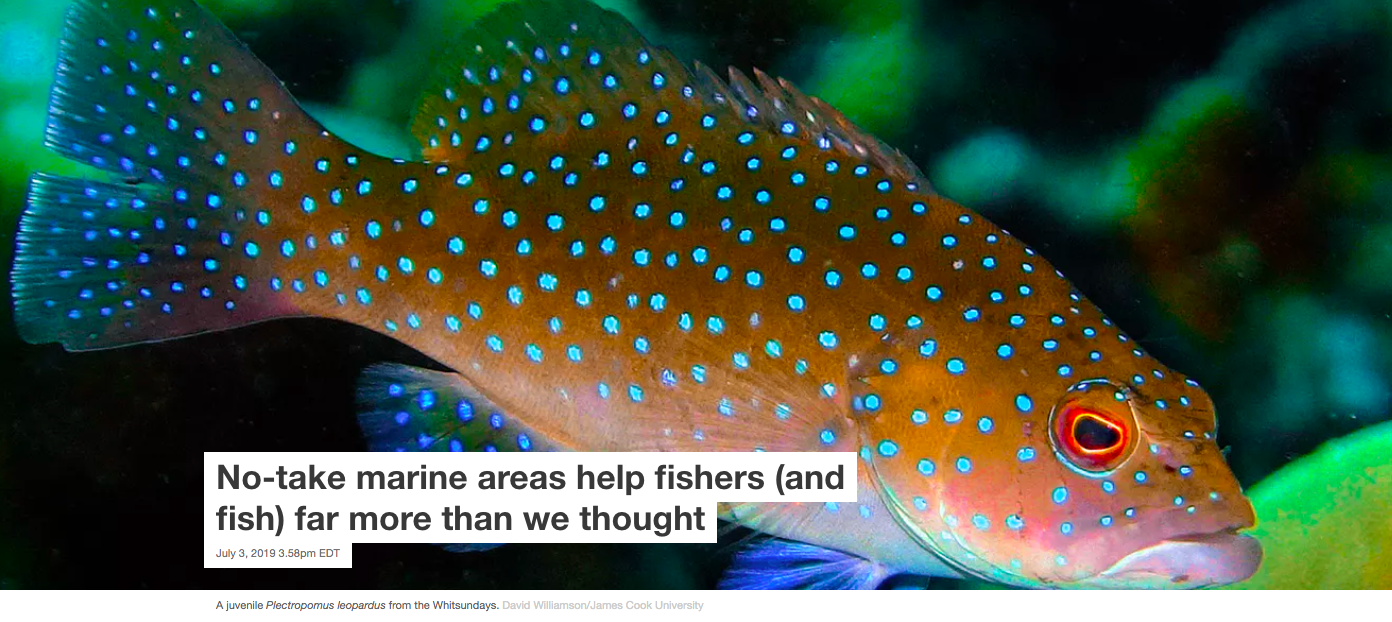
No-take marine areas help fishers (and fish) far more than we thought
July 3, 2019 3.58pm EDT
One hectare of ocean in which fishing is not allowed (a marine protected area) produces at least five times the amount of fish as an equivalent unprotected hectare, according to new research published today.
This outsized effect means marine protected areas, or MPAs, are more valuable than we previously thought for conservation and increasing fishing catches in nearby areas.
Previous research has found the number of offspring from a fish increases exponentially as they grow larger, a disparity that had not been taken into account in earlier modelling of fish populations. By revising this basic assumption, the true value of MPAs is clearer.
Marine Protected Areas
Marine protected areas are ocean areas where human activity is restricted and at their best are “no take” zones, where removing animals and plants is banned. Fish populations within these areas can grow with limited human interference and potentially “spill-over” to replenish fished populations outside.
Obviously MPAs are designed to protect ecological communities, but scientists have long hoped they can play another role: contributing to the replenishment and maintenance of species that are targeted by fisheries.
Wild fisheries globally are under intense pressure and the size fish catches have levelled off or declined despite an ever-increasing fishing effort.
Yet fishers remain sceptical that any spillover will offset the loss of fishing grounds, and the role of MPAs in fisheries remains contentious. A key issue is the number of offspring that fish inside MPAs produce. If their fecundity is similar to that of fish outside the MPA, then obviously there will be no benefit and only costs to fishers.
Big fish have far more babies
Traditional models assume that fish reproductive output is proportional to mass, that is, doubling the mass of a fish doubles its reproductive output. Thus, the size of fish within a population is assumed to be less important than the total biomass when calculating population growth.
See Full Article at Source: https://theconversation.com/no-take-marine-areas-help-fishers-and-fish-far-more-than-we-thought-119659
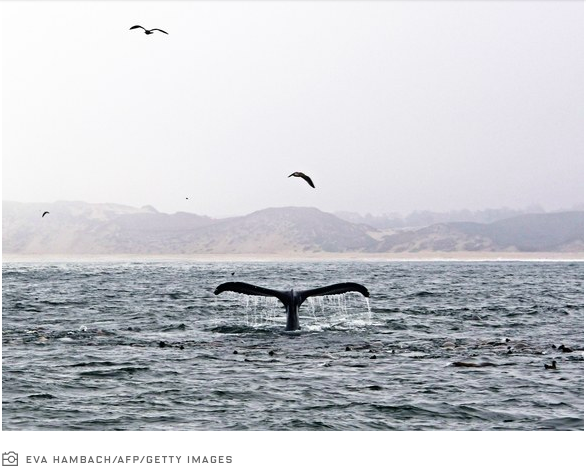
MONTEREY BAY IS A NATURAL WONDER—POISONED WITH MICROPLASTIC
AUTHOR: MATT SIMON SCIENCE 06.06.1909:00 AM
CALIFORNIA’S MONTEREY BAY is one of the more pure, more dynamic coastal ecosystems on Earth. Otters—once hunted nearly to extinction—float among towering kelp forests, which themselves have rebounded thanks to the booming otter population’s appetite for kelp-loving sea urchins. Great whites visit from time to time, as do all manner of whales and dolphins. All told, it’s one of the greatest success stories in the history of oceanic conservation.
Yet it’s poisoned with a menace no amount of conservation can stop: microplastic. Today in the journal Nature Scientific Reports, researchers present a torrent of horrifying findings about just how bad the plastic problem has become. For one, microplastic is swirling in Monterey Bay’s water column at every depth they sampled, sometimes in concentrations greater than at the surface of the infamous Great Pacific Garbage Patch. Two, those plastics are coming from land, not local fishing nets, and are weathered, suggesting they’ve been floating around for a long while. And three, every animal the researchers found—some that make up the base of the food web in the bay—were loaded with microplastic.
See Full Article at Source: https://www.wired.com/story/monterey-bay-microplastic/
People 'eating a credit card' each week
The average person ingests a credit card worth of microplastics each week through drinking water and consumables such as beer and shellfish.
UPDATED 12/06/2019
The average person could be ingesting 2000 tiny pieces of plastic every week - the equivalent of a credit card - with drinking water the largest source.
The No Plastic in Nature report from the University of Newcastle, commissioned by the World Wildlife Fund, suggests people around the world are consuming about five grams of microplastics per week, or just over 250 grams annually.
The study combines data from over 50 studies on the ingestion of microplastics, which are plastic particles under five millimetres in size.
Drinking water is the largest contributor, with the plastic particles found in bottled, tap, surface and groundwater all over the world.
Shellfish, beer and salt are the consumables with the highest recorded levels of plastic.
WWF International's director general Marco Lambertini says the findings should serve as a wake-up call to governments.
"Not only are plastics polluting our oceans and waterways and killing marine life - it's in all of us and we can't escape consuming plastics," he said in a statement.
"Global action is urgent and essential to tackling this crisis."
See Full Article at Source: https://www.sbs.com.au/news/people-eating-a-credit-card-each-week
Asian countries take a stand against the rich world’s plastic waste
JUN 17, 2019
When the MV Bavaria cargo ship chugged out of a Philippine port one morning last month carrying 69 containers of rotted Canadian garbage, it didn’t just end a messy diplomatic spat between the two countries.
It also signaled a sea change in the global recycling system.
After years of pressure, Canada had agreed to take back the waste, which had been exportedto the Philippines beginning in 2013 falsely labeled as plastic scrap. The shipments were part of a decades-old practice in which rich countries including the United States sent used plastic to Asia to be recycled. Often, the shipments included contaminated waste that couldn’t be recycled but made it past customs checks anyway, and countries had few legal avenues to send it back.
That began to change 18 months ago, when China, the biggest consumer of discarded plastics, banned nearly all waste imports to stop the smuggling of non-recyclable scrap. The trade in plastics quickly rerouted to neighboring Southeast Asian countries that lacked effective recycling plants and disposal laws, leaving much of the waste to be burned or dumped in fields and waterways, creating health and environmental hazards.
See Full Article at Source: https://www.latimes.com/world/la-fg-asia-plastic-waste-20190617-story.html

How America Is Sabotaging The Global War On Plastic Waste
Most nations have banded together to tackle the crisis, but the U.S. keeps undermining their efforts.
When President Donald Trump signed the bipartisan Save Our Seas Act into law last October, he painted a grim picture of just how dire marine plastic pollution had become.
“Every year, over 8 million tons of garbage is dumped into our oceans,” he declared. “This waste, trash and debris harms not only marine life, but also fishermen and coastal economies along America’s vast stretches.”
While it is true that Asia is the source of an estimated 80% of marine plastic pollution, what Trump failed to mention was that most of it doesn’t actually originate there.
“It’s an uncomfortable fact that ... the vast majority of the waste in these Asian countries that are ending up in the oceans actually come from the U.S. and Europe,” David Azoulay of the Center for International Environmental Law said from Geneva on Thursday.
The U.S., which is one of the world’s largest producers and consumers of plastic, is also the No. 1 exporter of plastic scrap.
For decades, it sent much of this waste to China, which had processed about 45% of the world’s plastic scrap until it decided in 2018 to bar most of these imports. As a result, China’s Southeast Asian neighbors have been deluged with American plastic waste. Unlike China, however, countries like Indonesia, Malaysia and Vietnam have neither the infrastructure nor the resources to properly handle this onslaught.
As a HuffPost investigation uncovered earlier this year, bales of plastic trash from countries like the U.S., U.K. and Australia are being illegally dumped or burned across Southeast Asian countries. Local activists in Malaysia said at the time that the U.S. and other wealthy nations were using the region as a “dumping ground.”

UN adopts global treaty limiting plastic waste trade
Hoping to slow plastic pollution in the environment, members at a high-level United Nations meeting May 10 decided to include plastic waste in a treaty governing trade in hazardous waste.
The changes in the Basel Convention, which were pushed by Norway and adopted by the 187-nation body, create a legally-binding and potentially far-reaching framework that will put tighter controls on buying and selling of plastic scrap and waste.
At a news conference at the close of the meeting in Geneva, U.N. officials also made note of huge petition drives on social media urging the Basel negotiators to act on plastics waste.
"Plastic waste is acknowledged as one of the world's most pressing environmental issues, and the fact that this week close to 1 million people around the world signed a petition urging Basel Convention Parties to take action here in Geneva ... is a sign that public awareness and desire for action is high," said Rolph Payet, executive secretary of the Basel, Rotterdam and Stockholm Conventions, a U.N. agency.
Read Full Article at Source: https://www.plasticsnews.com/article/20190510/NEWS/190519991/un-adopts-global-treaty-limiting-plastic-waste-trade

London Marathon Runners Were Handed Seaweed Pouches Instead Of Plastic Bottles
Trevor Nace Contributor
London Marathon runners were given a surprising thirst quencher during their run: edible seaweed pouches filled with a sports drink.
The seaweed pouch campaign during the marathon, which took place yesterday on April 28, 2019, helped to reduce the use of hundreds of thousands of plastic bottles. Marathon organizers have grappled with the sea of plastic bottles left over after over 40,000 runners quenched their thirst with single-use bottles of water and sports drink.
However, in the 2019 London Marathon organizers planned to replace 200,000 plastic bottles with innovative seaweed pouches filled with a sports drink. The seaweed pouches, called Ooho, were produced by Skipping Rocks Lab. The seaweed capsules can be bitten to release the liquid inside and eventually entirely consumed, or if the runner prefers not to eat the seaweed film it can be discarded where it will break down quickly.
Read full article at Source: https://www.forbes.com/sites/trevornace/2019/04/29/london-marathon-runners-were-handed-seaweed-pouches-instead-of-plastic-bottles/#22dc028b2ba2

Miniature transponder technology to be used in the war against ocean plastic
Low-cost acoustic tags attached to fishing nets are being trialled as part of a major new project to reduce marine litter and 'ghost fishing'.
Lost fishing gear—known as ghost nets—are a major threat to life in our oceans. Choking coral reefs, damaging marine habitats and entangling fish, marine mammals and seabirds, they are also a danger to boats, catching in the propellers. And they are a key source of plastic pollution, gradually breaking up and disintegrating to add to the growing volume of microplastics in the ocean.
Often lost during storms or in strong currents, the nets can travel long distances and can continue to fish for years afterwards—hence the phrase ghost fishing. Because of this, locating and removing the nets is both highly desirable and a major challenge.
The new NetTag project has been set up to try to reduce and prevent marine litter by developing new technology for the location and recovery of lost fishing gear based on miniature transponders—acoustic devices that pick up and automatically respond to an incoming signal. The project also aims to promote improved practices for the management of fishing waste.
The project is a collaboration between Newcastle University (UK) who develop underwater communication and tracking technology, CIIMAR (PT), INESC-TEC (PT), and the Universities of Aveiro (PT) and Santiago de Compostela (ES), together with stakeholders from the fishing industry across Europe.
Read full article at Source here: https://phys.org/news/2019-04-miniature-transponder-technology-war-ocean.html

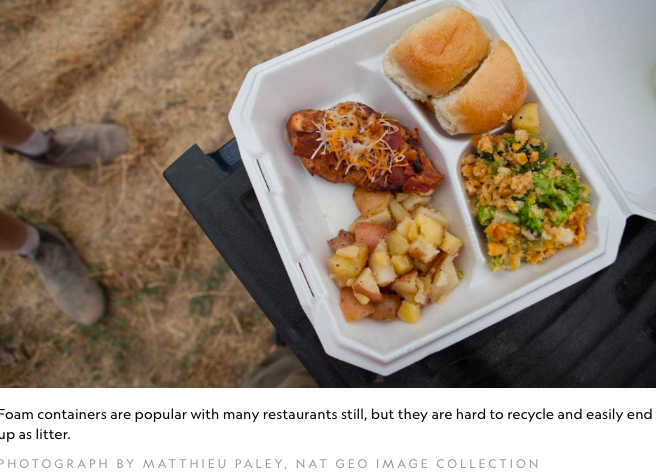
This state is poised to become the first to ban foam food packaging
Maryland's three-year effort built on public opinion that reached a "tipping point." BY LAURA PARKER
MARYLAND IS EXPECTED to become the first U.S. state to ban foam food packaging, takeout containers and cups—and the latest in a growing worldwide effort to ban various disposable single-use plastic products.
The new proposed law passed both of the state’s legislative chambers this week with enough votes to override a potential veto signed by Gov. Larry Hogan, who has not publicly signaled whether he supports the law or not. The law would become the latest in a growing effort worldwide to ban an assortment of disposable, single-use plastic products, due to their impacts on the environment. Hogan reportedly has six days to sign or veto the law.
Prior to the statewide ban effort, Maryland’s two most populous counties—Prince George’s and Montgomery, which both border Washington, D.C.—had already banned foam packaging.
Del. Brooke Lierman (D-Baltimore), who sponsored similar legislation last year and in 2017, says changing public opinion helped her third attempt succeed (it was approved 100-37 in the House of Delegates).
“I think we’ve reached a tipping point,” she says. “People are seeing how ubiquitous single-use plastics are, that they are not recyclable and never going away. People are beginning to understand the importance of living more sustainably.”
Read full article at source here: https://www.nationalgeographic.com/environment/2019/04/maryland-styrofoam-food-packaging-ban/?cmpid=org=ngp::mc=social::src=twitter::cmp=editorial::add=tw20190410env-styrofoamban::rid=&sf210759299=1