
NEWS / BLOGS
Fleets Of Wasteshark 'Aquadrones' Could Be Cleaning Ocean Waste In The Future
A swarm of autonomous robots that can swim across bodies of water to collect garbage might be the key to saving the oceans.
A few years ago, RanMarine Technology, a company from the Netherlands, has introduced WasteShark, an aquadrone that works like a smart vacuum cleaner (essentially, a Roomba for the seas) to gather wastes that end up in waterways before they accumulate into a great big patch in the middle of the Pacific Ocean.
Wall-E On Water
Every year, about 1.4 billion pounds of trash end up in the ocean. Plastics, styrofoam, and other nonbiodegradable materials get dumped into the waters, eaten by fishes and birds or collect into what has become the Great Pacific Garbage Patch — a gyre of debris between California and Hawaii bigger than Alaska.
Trash in seas and oceans have become a huge problem, but the WasteShark might be able to help.
RanMarine said that its aquadrones are inspired by whale sharks, "nature's most efficient harvesters of marine biomass." The company claims that the vessels can collect up to 200 liters of waste before it needs to be emptied and swim across the water for 16 hours.
See full article here: https://www.techtimes.com/articles/233611/20180823/fleets-of-wasteshark-aquadrones-could-be-cleaning-ocean-waste-in-the-future.htm

Can Norway help us solve the plastic crisis, one bottle at a time?
A bottle deposit hub on the outskirts of Oslo has had a stream of high-level international visitors. Can its success be replicated worldwide?
Tens of thousands of brightly coloured plastic drinks bottles tumble from the back of a truck on to a conveyor belt before disappearing slowly inside a warehouse on the outskirts of Oslo.
As a workman picks up a few Coke bottles that have escaped, Kjell Olav Maldum looks on. “It is a system that works,” he says as another truck rumbles past. “It could be used in the UK, I think lots of countries could learn from it.”
Maldum is the chief executive of Infinitum, the organisation which runs Norway’s deposit return scheme for plastic bottles and cans. Its success is unarguable – 97% of all plastic drinks bottles in Norway are recycled, 92% to such a high standard that they are turned back into drinks bottles. Maldum says some of the material has been recycled more than 50 times already. Less than 1% of plastic bottles end up in the environment.
See full article here: https://www.theguardian.com/environment/2018/jul/12/can-norway-help-us-solve-the-plastic-crisis-one-bottle-at-a-time

ASU scientists report 1st nationwide study showing environmental costs of lenses
Every year, about 45 million Americans rely on contact lenses to see the world more clearly. This $2.7 billion U.S. market has made contact lenses more comfortable and disposable. Every day, these plastic lenses are tossed away by consumers in various ways, perhaps without much thought to their ultimate environmental fate.
Now, Arizona State University scientists are reporting the first nationwide study that shows consumers, by discarding used lenses down the drain, may be unknowingly contributing to plastic pollution.
The ASU research team is presenting their results today at the 256th National Meeting and Exposition of the American Chemical Society (ACS), held in Boston from August 19–23.
The inspiration for this work first began from personal experience.
“I had worn glasses and contact lenses for most of my adult life,” said Rolf Halden, director of the Biodesign Institute’s Center for Environmental Health Engineering at ASU. “But I started to wonder, has anyone done research on what happens to these plastic lenses after their useful lifespan is over?”
See full article here: https://asunow.asu.edu/20180819-discoveries-asu-scientists-1st-nationwide-study-environmental-costs-contact-lenses?utm_campaign=ASU_Now%208-20-18&utm_medium=email&utm_source=ASU%20Now&utm_term=ASU&utm_content=%20https%3a%2f%2fasunow.asu.edu%2f20180819-discoveries-asu-scientists-1st-nationwide-study-environmental-costs-contact-lenses

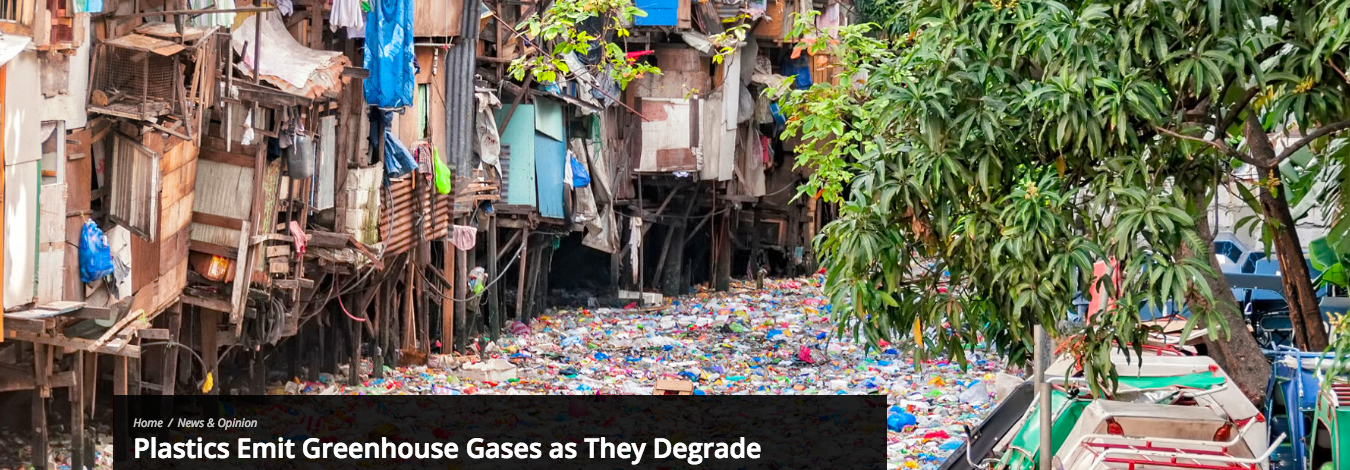
Plastics Emit Greenhouse Gases as They Degrade
The materials are a previously unaccounted-for source of methane and ethylene, researchers find.
Aug 2, 2018
SHAWNA WILLIAMS
Need another reason to ditch straws? A study published yesterday (August 1) in PLOS ONE reports that plastics—ranging from construction materials to plastic bags—release the greenhouse gases methane and ethylene after being exposed to sunlight and beginning to degrade.
“Our results show that plastics represent a heretofore unrecognized source of climate-relevant trace gases that are expected to increase as more plastic is produced and accumulated in the environment,” the study authors write in their paper.
The researchers, all based at the University of Hawai‘i at Manoa, tested the emissions of seven types of plastics as they degraded: polyethylene terephthalate, polycarbonate, high-density polyethylene and low-density polyethylene (LDPE), acrylic, polypropylene, and polystyrene. All gave off methane and ethylene in the days after being exposed to sunlight, they found, but polyethylene, which is used to make plastic bags, was the worst offender.
See full article at source: https://www.the-scientist.com/news-opinion/plastics-emit-greenhouse-gases-as-they-degrade-64600
We’re Literally Eating and Drinking Plastic. Fossil Fuels Are To Blame.
The plastics industry sees fracking as a huge opportunity for their profit margins. But plastic has already entered our food and water supply and our bodies—one more reason we need to move off fossil fuels before the problem gets even worse.
07.30.18
Care about plastic pollution? Then it’s time to work to start moving away from fossil fuels.
Plastic is a serious problem, and it’s time we addressed it at its source: fossil fuel production. Plastics are increasingly fueled by fracking in the U.S.—the extreme method of extracting fossil fuels that is polluting our air and our water, and exacerbating climate change. Fracking provides the cheap raw materials for plastics production, which has lead industry publication Plastics News to say fracking “represents a once-in-a-generation opportunity.” More fracking equals more profit in plastics (which equals, you guessed it…more plastics.)
It is so pervasive in our environment that it’s become commonplace to digest it through the microplastics present in our food and water.
Plastic in Water, Salt…Even Beer?
Everyone drinks water, and whether you drink tap water or bottled water, you are very likely ingesting some level of plastic pollution. A recent study by Orb Media tested 159 drinking water samples from cities and towns around the world, and 83 percent of those samples contained microplastic fibers. That means food prepared with plastic-contaminated water becomes contaminated as well.

Bottled water samples fared even worse than tap water—unsurprising because it is manufactured with plastic. Another recent study by the same organization found 90 percent of bottled water analyzed from around the world contained plastic microfibers. A single bottle of Nestlé Pure Life had concentrations of microfiber plastics up to 10,000 pieces per liter. The type of plastic used to make bottle caps was the most common type of microplastic fiber found in bottled water.
See full article at source: https://www.foodandwaterwatch.org/news/were-literally-eating-and-drinking-plastic-fossil-fuels-are-blame
Ocean acidification to hit levels not seen in 14 million years
New research led by Cardiff University has shown that under a 'business-as-usual' scenario of carbon dioxide (CO2) emissions, ocean acidification is likely to hit unprecedented levels.
Ocean acidification occurs when CO2 from the atmosphere is absorbed by seawater, resulting in more acidic water with a lower pH.
Around a third of the CO2 released by burning coal, oil and gas gets dissolved into the oceans. Since the beginning of the industrial era, the ocean has absorbed around 525 billion tons of CO2, equivalent to around 22 million tons per day.
The rapid influx of CO2 in to the oceans is severely threatening marine life, with the shells of some animals already dissolving in the more acidic seawater.

In their new study, published in the journal Earth and Planetary Science Letters, the researchers set out to reconstruct levels of ocean acidity and atmospheric CO2 levels over the past 22 million years.
See full article at: https://phys.org/news/2018-07-ocean-acidification-million-years.html#jCp
PLANET OR PLASTIC? How India’s Fishermen Turn Ocean Plastic Into Roads
In an innovative project, fishermen in Kerala collect ocean plastic for recycling, cleaning the ocean in the process.
BY MAANVI SINGH
PUBLISHED MAY 23, 2018
This story is part of Planet or Plastic?—our multiyear effort to raise awareness about the global plastic waste crisis. Learn what you can do to reduce your own single-use plastics, and take your pledge.
KOLLAM, INDIAKadalamma—Mother Sea—that’s what Xavier Peter calls the Arabian Sea. His own mother gave him life, but Kadalamma gave him purpose, a livelihood. She has provided for him, offering up enough fish to feed his family and sell at the market. And she has protected him, sparing him thrice from cyclones and once from a tsunami.
Xavier has been trawling for shrimp and fish off India’s southwestern coast for more than three decades, his whole adult life. But lately, when he casts out his nets, he often comes up with more plastic than fish.
“Pulling the nets out of the water is extra effort, with all this plastic tangled in them,” he says. “It’s a bit like trying to draw water from a well—your bucket is somehow being weighed back down.”
See full article at source: https://news.nationalgeographic.com/2018/05/fishermen-kerala-india-recycle-plastic-pollution-culture/?beta=true

A fisherman in Kerala, India, repairs nets on a beach. Plastic pollution can damage and clog nets, but now fishermen are fighting back.
PHOTOGRAPH BY FRANK BIENEWALD, GETTY IMAGES
IMPACTS OF SUNSCREENS ON CORAL REEFS
FUNDED WITH THE SUPPORT OF THE GOVERNMENT OF SWEDEN AND THE FONDATION POUR LA RECHERCHE SUR LA BIODIVERSITE
AUTHOR: ELIZABETH WOOD
This document responds to Goal 3(5) of the International Coral Reef Initiative (ICRI) Plan of Action 2016-2018, which seeks to review issues relating to the impact of sunscreens on coral reefs.
Sunscreens contain organic (chemical) and/or inorganic (mineral) UV filters that absorb, reflect or scatter UV light. They also contain inactive ingredients such as antimicrobial preservatives, moisturisers and anti-oxidants. Sunscreen ingredients including chemical (benzophenone-3 and -4 (BP-3 or oxybenzone; BP-4), ethylhexyl methoxy cinnamate (EHMC), homosalate (HMS), 4-methylbenzylidene camphor (4-MBC), diethylamino hydroxybenzoyl hexyl benzoate (DHHB)) and mineral (titanium dioxide and zinc oxide) UV filters have been detected in coastal waters. UV filters reach coastal waters either directly as a consequence of washing off swimmers and/or indirectly from wastewater treatment plant effluents. Many of these components have also been found in marine biota including fish, molluscs and corals as well as in sediments.
See full article at source: https://www.icriforum.org/sites/default/files/ICRI_Sunscreen_0.pdf

Girl Scout Convinces Alaska Airlines to Bump Plastic Straws Off All Flights
By CHRIS MORRIS
May 21, 2018
Alaska Airlines is kicking plastic straws off of its planes.
The carrier has announced plans to eliminate single-use plastic straws and drink stirrers on all flights, following the pleas of a 16-year old Girl Scout.
Shelby O’Neil, a Girl Scout who founded ocean conservation group Jr. Ocean Guardians, reached out to Alaska Airlines last year, pointing out the negative environmental impact of the plastic straws, 22 million of which the carrier used last year. Officials at the airline say they were already considering making the change.
Starting this summer, all Alaska Airlines flights will replace the straws, stirrers and toothpicks with sustainable, marine-friendly options, including white birch and bamboo. The carrier is working with Seattle-based nonprofit Lonely Whale to support the switchover.
See full article at source: http://fortune.com/2018/05/21/alaska-airlines-bans-plastic-straws/

Galapagos Restricts Single-Use Plastics for Earth Day 2018
So far this year, approximately 22 tons of plastic trash have been collected in surface and submarine cleanups along the coasts of San Cristóbal, Santa Cruz, Floreana, and Santiago Islands in Galapagos. The pollution caused by this type of waste is not only visual but is also of serious environmental impact, affecting the wildlife species that inhabit the Archipelago.
Research studies have identified several types of microplastics inside animals or in their feces: birds like finches and marine animals like sea turtles confuse plastics with food, ingesting them. Over time, this can lead to the death of these species. At least 18 species have been recorded in the Archipelago as either being entangled by, or ingesting, plastic to date as well.
The transfer of marine garbage in the water currents and human behavior are considered the two most significant contributing factors to the plastic pollution problem in Galapagos. In light of this, Minister of the Governing Council of Galapagos Lorena Tapia has expressed her wish to implement regulations to restrict the consumption of single-use plastics in the insular region, and on Sunday, April 22, as part of the commemoration of Earth Day, the highest provincial authority announced Resolution No. 05-CGREG-2015 that restricts the use of certain plastics — including plastic straws, single-use plastic bags (t-shirt type), polythene containers (such as those used for takeout), and plastic bottles.
See full article at source: https://www.galapagos.org/newsroom/galapagos-sin-plasticos-2018/?utm_medium=email&utm_source=galapagos&utm_content=4&utm_campaign=GENEWSMAY18&source=GENEWSMAY18

Edinburgh inventor creates biodegradable water bottle to fight plastic problem
A Scottish entrepreneur has developed a new eco-friendly bottle that could help combat the growing mountain of plastic litter entering the world’s oceans.
A Scottish entrepreneur has developed a new eco-friendly bottle that could help combat the growing mountain of plastic litter entering the world’s oceans. Edinburgh-based chemistry graduate James Longcroft launched a not-for-profit bottled water firm two years ago, with the aim of ploughing all profits into a charity focused on providing clean drinking water to remote communities in Africa.
But the 27-year-old soon realised the product, although it was benefiting struggling villagers in some of the world’s poorest regions, was adding to an increasing blight on the environment. So last year he vowed to go plastic-free – his company, Choose Water, has sold no plastic bottles since. But that meant he had to find another way to continue funding the charitable works. After months of experiments at his kitchen table, he has now managed to create a novel bottle that he believes could revolutionise the industry.
See full article at source: https://www.scotsman.com/news/environment/edinburgh-inventor-creates-biodegradable-water-bottle-to-fight-plastic-problem-1-4731899

Inventor James Longcroft on Granton Harbour Wall
Hawaii bans sunscreens deemed harmful to coral reefs
Hawaii has become the first US state to ban sunscreens deemed harmful to coral reefs.
Looking forward to a day exploring coral reefs in Hawaii? Make sure you're wearing the right, non-banned sunscreen.
Hawaii has become the first US state to ban sunscreens deemed harmful to coral reefs. Effective from Jan. 1, 2021, the bill was signed by state governor David Ige on Tuesday.
The legislature focuses on the environmental impacts of two chemicals found in some sunscreens, oxybenzone and octinoxate, and their effect on Hawaii's marine ecosystems — including coral reefs. The bill will prohibit the sale and distribution of sunscreen containing these chemicals without a prescription.
See full article at source: https://www.yahoo.com/news/hawaii-bans-sunscreens-deemed-harmful-054453351.html

By 2050 There Will Be More Pounds Of Plastic In Oceans Than Fish
By the year 2050 there will be more pounds of plastic in the ocean than there will be fish. But since we don’t live in the ocean why should we care? It’s actually pretty simple – the fish we eat comes from the ocean, and that fish is filled with plastic and many marine animals are dying from starvation because they are ingesting all that plastic. Even the microplastic is making its way up the food chain with dire consequences. But what’s more, we can’t even begin to clean it all up until we stop letting it get there to begin with. The oceans are too deep to dredge and microplastic is too small to get it all. Where do we even begin?
See full article at source: https://www.valuewalk.com/2018/04/ocean-garbage-plastic-2050/

New competition launched to tackle ocean plastics by reducing lost fishing gear
April 30, 2018

Circular Ocean has launched an innovation competition, designed to engage creative and technical communities to provide new ideas and solutions related to the re-use and recycling of end-of-life fishing nets in the Northern Periphery and Arctic (NPA) region.
Circular Ocean, a three-year European project that seeks opportunities to recover and reuse of waste commercial fishing gear with a view to benefiting local economies, is inviting competition entries from individuals as well as multi-disciplinary teams of entrepreneurs, inventors, designers and students who would like to tackle marine plastics with ideas, solutions and product concepts.
See Full Article at Source here: https://www.seafoodsource.com/news/environment-sustainability/new-competition-launched-to-tackle-ocean-plastics-by-reducing-lost-fishing-gear
Plastic-eating enzyme could aid recycling
Tom Ravenscroft, 20 April 2018
Scientists have discovered an enzyme that can "digest" plastic and revolutionalise recycling, but environmentalists warn the "miracle" breakthrough should not make designers complacent about the need to reduce use of the material.

Image is by University of Portsmouth.
Scientists at the University of Portsmouth and from the US Department of Energy "inadvertently engineered" the enzyme that rapidly breaks down polyethylene terephthalate (PET) – the rigid plastic commonly used to make drinks bottles.
The teams were investigating the structure of a naturally occurring bacteria that breaks down PET, when they accidentally engineered the new more efficient enzyme.
See full article at source here: https://www.dezeen.com/2018/04/20/plastic-eating-enzyme-petase-recycling-news/
Why the death of coral reefs could be devastating for millions of humans
Coral reefs around the globe already are facing unprecedented damage because of warmer and more acidic oceans. It’s hardly a problem affecting just the marine life that depends on them or deep-sea divers who visit them.

A diver checks the bleached coral at Heron Island on the Great Barrier Reef in Australia. Large parts of the reef could be dead within 20 years as climate change drives mass coral bleaching, scientists have warned. (The Ocean Agency/XL Catlin Seaview Survey/Agence France-Presse via Getty Images)
If carbon dioxide emissions continue to fuel the planet’s rising temperature, the widespread loss of coral reefs by 2050 could have devastating consequences for tens of millions of people, according to new research published Wednesday in the scientific journal PLOS.
To better understand where those losses would hit hardest, an international group of researchers mapped places where people most need reefs for their livelihoods, particularly for fishing and tourism, as well as for shoreline protection. The researchers combined those maps with others showing where coral reefs are most under stress from warming seas and ocean acidification.
Countries in Southeast Asia such as Indonesia, Thailand and Philippines would bear the brunt of the damage, the scientists found. So would coastal communities in western Mexico and parts of Australia, Japan and Saudi Arabia. The problem would affect countries as massive as China and as small as the tiny island nation of Nauru in the South Pacific.
Read the full article at source: https://www.washingtonpost.com/news/energy-environment/wp/2016/11/09/why-the-death-of-coral-reefs-could-be-devastating-for-millions-of-humans/?utm_term=.8c03d476e0e8
You've got bottle: 7 brands who turn plastic waste into posh fashion
Eight million metric tonnes of plastic is dumped into the ocean each year. If we’re not careful by 2050 there will be more bits of plastic than fish. Forward thinking fashion brands are turning the waves of wasted plastic bottles into clothing, shoes and bags.
See full article and 7 awesome brands here: https://pebblemag.com/magazine/living/7-brands-who-turn-plastic-bottles-into-posh-fashion

The company turning 4 billion plastic bottles into clothes

Some 400,000 college students will accept diplomas this year while wearing gowns made entirely of plastic bottles.
It's not a joke or a gimmick. It's a statement on how to keep trash out of landfills, said Jay Hertwig, VP of global branding for textile maker Unifi.
Unifi, based in Greensboro, North Carolina, produces 300 million pounds of polyester and nylon yarn annually.
"As a manufacturer, we asked ourselves what we could do to be more innovative and a socially responsible company," said Hertwig.
Repreve was the answer. It's the firm's flagship fiber brand made from recycled materials.
See original source here: http://money.cnn.com/2016/05/16/technology/plastic-bottles-fabric-repreve/index.html
A sperm whale that washed up on a beach in Spain had 64 pounds of plastic and waste in its stomach

El Valle Wildlife Center found 64 lbs of plastic waste on a young sperm whale.
When a young sperm whale washed up on a beach in southern Spain, scientists wanted to know what killed it. They now know: waste -- 64 pounds of it. Most of it plastic, but also ropes, pieces of net and other debris lodged in its stomach.
The discovery has prompted authorities in Murcia, Spain, to launch a campaign to clean up its beaches.
"The presence of plastic in the ocean and oceans is one of the greatest threats to the conservation of wildlife throughout the world, as many animals are trapped in the trash or ingest large quantities of plastics that end up causing their death," Murcia's general director of environment, Consuelo Rosauro said in a statement.
Read the full article at source: www.cnn.com/2018/04/11/health/sperm-whale-plastic-waste-trnd/index.html
Garbage in the Ocean
Garbage in the Ocean, by Julia Hill

Marine debris or garbage consists of man-made materials that collect in our oceans. Plastics, wood, metal, and other manufactured products are now found throughout the world’s oceans where, after being carried by wind and currents, they often form large garbage patches within circular ocean currents or gyres. There are several of these garbage patches worldwide with the largest in the Indian Ocean, North and South Atlantic, and North and South Pacific. The North Pacific Gyre or Great Pacific Garbage Patch, stretching between Japan and California, is so large that it is divided into eastern (between Hawaii and California) and western (near Japan) segments. While these “garbage patches” conjure up images of floating islands of trash, they are often composed of smaller particles that cloud the water and larger pieces of debris that sink to the ocean floor. Current estimates show that there are over 5.25 trillion pieces of garbage in marine environments worldwide. These garbage patches continue to grow as plastics and other goods make their way to our oceans.
How garbage reaches our oceans
Most of this garbage, about 80%, comes from land. Inefficient industrial practices and over-taxed sewage or waste removal centers allow garbage from our streets to reach waterways. Whether carried by rivers or floods, these items then make their way to the ocean. The remaining 20% is dumped directly by ocean vessels like fishing trawlers and cargo ships as well as offshore oil drilling rigs. Cruise ships are one of the biggest culprits representing less than 1% of the global merchant fleet but producing about 25% of merchant vessel waste.

Impacts on ecosystems
For marine animals, most harm from marine debris revolves around ingestion and entanglement. Sea turtles have been known to mistake floating plastic bags for jellyfish. Sea-faring birds such as albatrosses confuse floating plastic pellets with fish eggs and feed them to their young, resulting in compacted digestive tracts, ruptured organs, and starvation. Whales, sharks, and sea lions drown after becoming entangled in discarded fishing nets.
Debris collecting on the ocean surface can interrupt sun exposure and growth of plankton and algae that form the base of the marine food chain. Disruption at this level causes problems for smaller fish all the way up to whales and sharks. This same debris can also act as a vessel for non-native species to reach new habitats, disrupting isolated environments on islands and coral reefs.
Last, but not least, is the impact of pollutants on the marine environment. Plastics can leach harmful chemicals while also absorbing others. When marine animals ingest this polluted material they may suffer directly (i.e., liver toxicity) or indirectly as these toxins make their way up the oceanic food chain. Concentrations of these pollutants in the water column damage overall ecosystem health and result in less stable environments.
What is currently being done and how we can help
Cleaning up debris once it has reached our oceans is no easy task. Organizations such as The Ocean Cleanup are working on ways to tackle this problem with the goal of removing 50% of the Great Pacific Garbage Patch within the next five years. Oceana uses its global reach to protect our oceans by targeting government policy changes in countries with the most influence. Since this issue starts on land, focus on stronger sewage and waste removal systems alongside recycling programs can produce positive results. Beach cleanups and recycling programs are effective at the community level while individuals can have an impact by taking more care in the products they purchase. Less consumption and more recycling will have a positive influence on all environments and result in less debris reaching our oce